Friday, May 18, 2012

Food Revolution Day

Obesity rates are staggering for the United States.  Childhood obesity and onset of "adult" (Type 2) diabetes in children are at epidemic rates.  It's time to take a stand and make a change.   May 19th is designated as "Food Revolution Day" by the Jamie Oliver Foundation.  According to their website, "Food Revolution Day is about connecting with your community through events at schools, restaurants, local businesses, dinner parties and farmers' markets. We want to inspire change in people’s food habits and to promote the mission for better food and education for everyone."

Now is the time you can make a conscious effort to think about where you food comes from and how you can make better choices.  Where can you start?  Stop by the Lexington Farmer's Market on May 19 and look for the Food Revolution Day table.  Grab some info on choosing fresh, unprocessed foods then peruse the many vendors from Central Kentucky and load up on some spectacular, locally-grown fruits and vegetables.

Meal planning isn't difficult but it does take some effort on your part.  When grocery shopping, take your time and look at food labels.  Compare brand items and watch for hidden sugars and fats.  Shop the perimeter of the store where the fresh foods are and stay away from the processed food aisles.  Not sure what to do with all the fresh foods?  Take a cooking class or search healthy eating websites for tasty (and healthy) recipes.  Better yet, talk with the farmers/growers at the farmer's market and find out how the best enjoy their products. 

Take a stand and vow to make a difference in your family's eating habits.  Choose a different fruit and vegetable each week to "highlight" in your kitchen.  Experiment with different tastes and textures.  You never know, you just might find new items to add to your dinner table.  Get your family (kids too) involved in meal preparation so it becomes a fun thing to do together.  You will be teaching your children better eating habits and how to make wiser food choices.

Wednesday, May 16, 2012

Body Composition...Do You Know Yours?

Do you religiously step on the scale every week to check your progress with weight loss?  Are you struggling with losing that last 5-10 pounds?  Have you already lost the weight and are looking to maintain your successes?  Instead of just stepping on that scale, you should have your body composition analyzed by a health/fitness professional.  While just looking at body weight is important, it is also wise to know exactly how much fat mass you have versus lean mass.  Fitness professionals can analyze body composition in a number of ways:  waist-to-hip ratio, BMI (body mass index), and body fat calculation.  

First, let's look at waist-to-hip ratio.  This is a general way for a health and fitness professional to estimate your health risk for diseases such as obesity, heart disease, and diabetes.  Circumference measurements are taken of the smallest part of your natural waist (just above the belly button) and the widest part of your hips/buttocks.  Then divide the waist measurement by the hips (both in inches).  Low risk for women is 0.8 or below and 0.95 or below for men.  Essentially "apple-shaped" bodies are more at risk than "pear-shaped" ones.  

Next, BMI or body mass index, can be calculated.  This test looks at your height versus your weight.  Here's the formula for calculating BMI:  weight (lb) / [height (in)]2 x 703.  For example if you are 5'5" (65 inches) and weigh 150 pounds the formula looks like this:  [150 / (65x65)] x 703 or [150 / 4225] x 703.  Your calculation would be 24.96.  Healthy ranges for both adult men and adult women is 18.4 - 24.9.  Remember, this is an estimation of risk.  BMI calculation does not take into consideration how much lean mass a person has so BMI will be overestimated for individuals who have higher lean mass (i.e., body builders) and underestimated to those who have lost lean mass (i.e., elderly).

A more accurate picture of body composition can be obtained through body fat analysis.  This can be done through various testing procedures such as bioelectrical impedance (hand-held units), full-body scans such as BOD POD, and skinfold measurements (via calipers).  The most convenient and, probably more readily available, is bioelectrical impedance analysis (BIA).  This is the most inexpensive method and only requires a hand-held unit.  The principle behind BIA is that fat contains little water; most of the body’s water is in the lean compartment (i.e., muscle, bone, organs). Therefore, when an electrical current encounters fat, there is more resistance.  By measuring how easily currents move through the body, body fat can be estimated.

Full-body scans, such as BOD POD, are more expensive but provide much more detail.  These fiberglass units are designed to measure body weight and body volume (i.e., the body’s total size). Because fat is less dense than lean tissue, the weight-to-volume ratio can be used to predict percent body fat.  This is a little more "high-tech" and is usually found in university or hospital settings or in more specialized health/fitness clinics.

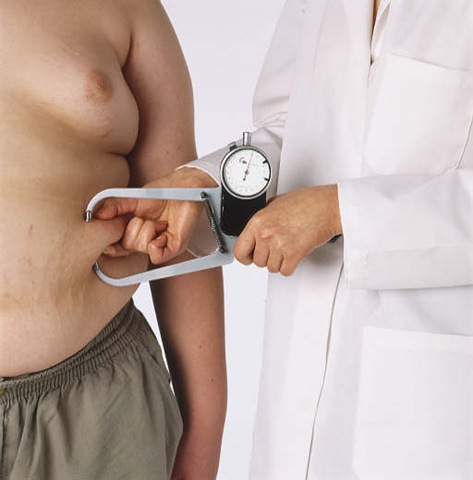
Finally, body composition can be analyzed via skinfold measurements.  Specialized calipers (i.e., "pinchers") are used to measure the thickness of skinfolds in certain areas.  These measurements are then entered into a lengthy calculation, taking into consideration height, weight, age, and gender.  While skinfold measurements are considered to be the "gold standard" of body composition measurements, it does require a specially-trained technician to perform this test.  Inaccurate measurements can drastically alter the final body fat calculation.

Now that you are familiar with some of the common procedures to analyze body composition, maybe it's time for you to have one of these tests done.  Whichever method you choose, it is important to have a fitness professional administer the test.  That way your results can be properly explained to you, health risks, if any, identified, and a plan of action can be developed.  Here at PROMATx Health Club, we have specially-trained fitness professional who can administer all of the methods listed above, with the exception of the BOD POD.

Remember, body composition can change but the number on the scale can remain the same.  You can lose fat and gain muscle at the same ratio and your body weight will remain unchanged.  Fitness professionals can help you determine healthy ranges of body fat for you as well as design a program geared towards improving your fat mass to lean mass ratio.  Don't just rely on your scale.  Get a better picture of your overall health and what your disease-related risks are.  Stop in today and make an appointment for a body composition analysis.  Don't worry...it won't hurt!  It will, however, arm you with valuable information to help you progress with your weight loss.  Call us today!!

Monday, May 14, 2012

Arthritis Awareness Month

There are lots of health observances this month including Employee Health and Fitness Month, National High Blood Pressure Education Month, National Osteoporosis Awareness and Prevention Month, National Women's Health Week, and National Senior Health and Fitness Day.  While all of these topics are important, today we will focus on Arthritis Awareness Month.

Do you suffer from arthritis?  Do you know someone who does?  Osteoarthritis (OA), also called osteoarthroses or degenerative joint disease, is the most common type of arthritis.  OA is a chronic condition characterized by the breakdown of the joint's cartilage.  This breakdown causes the bones to rub against each other, causing stiffness, pain, and loss of movement in the joint.  This chronic disease affects almost 27 million Americans.

A report from the Centers for Disease Control in 2009 shows that with the rise in obesity rates, more people are suffering from both obesity and arthritis. Obesity rates are 54% higher among adults with arthritis compared to those without the condition.  Unfortunately, Kentucky is among the top 20 states with the highest rates of obesity among adults with arthritis.  Specifically we are the 16th highest with 39.4%.

Even though arthritis can be a debilitating disease, it is important to remember that movement of the body is crucial to managing the disease.  You might think that because arthritis makes joints painful that it would be wise NOT to participate in physical activity.  However, movement keeps your joints lubricated with important fluid.  Weight training also helps by making the muscles around the joints stronger and able to support the body even though there is a deterioration of the cartilage.  Most importantly, movement/exercise can help reduce body weight, which in turn puts less stress on the joints.

Osteoarthritis can affect anyone but it doesn't mean you can be healthy and active.  Nolan Ryan (National Baseball Hall of Famer), Hank Aaron (National Baseball Hall of Famer), and Joe Namath (NFL Hall of Famer and Super Bowl MVP), all battle with OA yet they all still maintain an active lifestyle.  Don't let OA stop you (or loved ones) from being active.  Stop in at PROMATx Health Club and talk with a fitness professional to find out how you can manage your arthritis through exercise. 

Click HERE to go to the Arthritis Foundation's website to learn more about arthritis and how you can help others affected by this disease.

Thursday, May 10, 2012

Healthy Gifts for Moms

Mother's Day is fast approaching.  How are you going to say "thanks" and "I love you" to your mother this year?  Here are some healthy alternatives to a box of candy and flowers to show your appreciation to mom.
  1. Dark Chocolate - If your mom loves candy then why not treat her to a dose of heart healthy, dark chocolate.  Health benefits include decreasing stroke risk, protecting the skin, and boosting mom's mood.
  2. Fruit - Edible arrangements are gaining popularity.  Talented "fruit sculptors" can transform your mom's favorite fruits into a beautiful (and edible) bouquet.  This will also help your mom get her minimum of 5 servings of fruit and she will reap the benefits of all of the vitamins and minerals.
  3. Sweat Equity - Is your mom a fitness-fanatic?  Is she hoping to start on her own exercise program?  How about the gift of fitness?  Get your mom a gift certificate to a local gym or yoga studio.  Buy her some of her favorite exercise clothes/shoes.  Sweat equity goes a long way!!
  4. Tea - Make your mom a beautiful basket of teas and a pretty mug or teapot.  Tea contains less caffeine than coffee and is packed with antioxidants.  Also, some teas have heart healthy properties such as lowering blood pressure, cholesterol, and risk of heart disease and stroke.  With a variety of flavors, you can design (or purchase) a well-rounded, healthy basket for mom!
  5. Home Spa Kit - Is your mom always on the go?  Is she busy doing everything for everyone else but forgets to treat herself?  Put together a nice little home spa kit.  Add scented bath salts, a loofah, stress-reducing scented candles, even a nice bottle of wine so your mom can relax and enjoy some peace and quiet for a change.  Not possible for her to relax at home?  Then go for the professional help with a gift certificate for a massage or manicure/pedicure.  A few minutes for your mom can make a lasting impression!
  6. Sleep-Inducing Bedding - Help your mom improve the quality of her sleep with a set of organic cotton sheets.  As she slips into bed every night, these soft-as-silk sheets will wrap her in comfort and allow her body to get the relaxation and sleep she so deserves.
  7. Sight-Saving Specs - Is your mom an outdoorsy woman?  Why not treat her to a pair of sight-savers with polarized lenses and big enough frames to fully cover her eyes.  Some brands are even made out of sustainable nylon to help protect the environment while they protect your mom's eyes!!
  8. Hydration - Improve your mom's water intake by getting her a BPA-free water bottle.  With lots of pretty colors and designs, you are sure to find a bottle that will suit your mom's taste.  Water is important for weight loss and to allow the body to function at its peak performance.  Help your mom by getting her something she enjoys drinking out of and looks cool carrying!
  9. Clean Air - What???  You didn't read that incorrectly.  Improve the air quality in your mom's house by giving her house plants that help clean toxins out of the air she breathes.  Ferns and palms, peace lily, English ivy, and rubber plants all help to rid the air of pollutants and toxins while also helping to control internal humidity.  Give your mom a gift of fresh air!
  10. Gift of Love - Finally, and most importantly, how about giving your mom some quality bonding time.  Spend some extra time with her walking through the park or enjoying a lunch/dinner with just the two of you.  Treat her with love and tell her how much she means to you.
These are just a few ideas on how you can celebrate that wonderful woman in your life...your mother.  
Happy Mother's Day!!!

Monday, April 9, 2012

Is It Possible to Lose Weight While Eating Out?

What would you give up to lose weight?  Would you stop eating out at restaurants?  Recent research shows you may not have to give up dining trips to restaurants.  In a study published in the Journal of Nutrition Education and Behavior in January 2012, researchers at the University of Texas at Austin developed a "weight-gain prevention" intervention.  Their goal was not to provide a weight loss program but to teach participants how to prevent weight gain while still having the ability to eat out at restaurants.  In this study, 35 women between the ages of 40 and 59 who ate out frequently were recruited for this 6-week program.  The main purpose of this program was to teach participants how to reduce caloric and fat intake while eating out.

What was the outcome?  The intervention group not only prevented weight gain while eating out, they actually lost an average of 3.7 pounds.  How?  The skills these participants learned in the program carried over to their dietary habits at home.  Based on food journals completed in the study, the intervention group reduced their caloric intake at restaurants by 124 calories.  In addition, they reduced total daily calories by 297 calories (this includes the calorie reduction when eating out).  Therefore, this total calorie reduction resulted in weight loss.  What is even more interesting is that these participants did NOT reduce the number of times they ate out even though they participated in the study!!

So this shows us that it is possible to enjoy foods that other people cook and still at least maintain weight or even lose weight.  By learning skills on how to make better choices, we have the tools to make weight loss that much easier.  Where do you start?  First it is important to learn a little about food and what the "macronutrients" are in food.  Over the next few blog entries, we will look at macronutrients (i.e., fat, protein, carbohydrates) and teach you what they are and how they will affect your weight gain/maintenance/loss.  We will begin to teach you these skills necessary to make better choices.  

Still need extra help?  Why not come in to PROMATx Health Club and talk with our nutrition specialist?  Find out how well-balanced your nutrition is and find out how you can ensure you receive the proper nutrients.  As usual, we are here to help you but you have to make the first step.  Call us today and set up your appointment.  Make your weight loss permanent so you don't cycle through weight gain and weight loss every few years.

Study reference:  Elsevier Health Sciences (2012, January 10). Would you stop eating out to lose weight?. ScienceDaily. Retrieved April 9, 2012, from http://www.sciencedaily.com­ /releases/2012/01/120110093557.htm

Friday, April 6, 2012

Motivation and Weight Loss...Is There a Connection?

Many of us are motivated with the coming of a new year.  We make resolutions year after year but it seems as if those resolutions fall to the wayside by the time March comes around.  When it comes to weight loss, does motivation have anything to do with your success?  In February 2010, researchers from the University of Kentucky and University of North Carolina at Chapel Hill looked at the connection between motivation levels of individuals participating in a 16-week weight loss program.  The researchers looked at two types of motivation, autonomous and controlled.  Autonomous motivation is the type of motivation that comes from the individual participating in the program.  Controlled motivation came from the researchers in the form of phone calls, emails, internet support, etc.  Motivation levels were assessed at weeks 4, 8, 12, and 16.

According to this study, more than half of the participants lost 5% of their initial body weight at the end of the 16 weeks.  What was more interesting is the participants who were determined to have a higher level of autonomous motivation at week 4 were the individuals who lost 5% of their weight by the end of the study.  What does that mean?  When your motivation level decreases, especially between 4 and 8 weeks, weight loss success can decrease.  During this time frame, the researchers determined that increasing "controlled" motivation (i.e., social support, phone calls, emails) can benefit the person attempting to lose weight.

So how does this help you?  While we say kudos to you for losing weight on your own, sometimes it is helpful to have extra support.  That support can come in many ways from joining a weight loss program, seeking community support through meetings or internet groups, or enlisting the help and support of family and friends.  Again, according to this research study, this support can be especially important during your 2nd and 3rd month of weight loss.  Why try to do it on your own??  Support from family, friends, co-workers, and others attempting to lose weight is very beneficial.  Your own motivation levels will change so it's helpful to have a little extra support.

PROMATx Health Club has that support you are looking for when attempting to lose weight.  First, make an appointment to talk with our nutrition specialist.  From there, the two of you can decide how much support you will need.  We want you to be successful with your weight loss endeavors.  It shouldn't be a vicious cycle of gaining and losing weight.  Make the lifestyle changes today to make a healthier you tomorrow.  Call us today or stop by...we are here to help!!

Thursday, April 5, 2012

Balance Training...It's Not Just for the Elderly

How is your balance?  Do you find yourself tripping or slipping a little more than usual?  Balance training should be a key component to everyone's workout routine...regardless of age!!  Are you a weekend warrior or do you compete in adult sport leagues?  Balance training can help improve your game....give you a stronger swing or make you more agile on the field.

How can you test your balance?  Ideally, you should be able to stand on one leg, unsupported, for at least 20 seconds.  Try it out...how long can you stand there without having to put your other foot down?  Try it on both legs as you may have a difference in balance from one side to another.  Balance training can start with simple exercises such as shifting your weight side to side, forward and back, and at different angles forward and back.  From there progress to standing on one leg.  If your balance isn't very good in the beginning, hold onto something stable.  Progression on this exercise should be from holding on with both hands, to one hand, to just fingers, then to not holding on at all.  Do this with both legs so you can improve your balance on both sides.

Once you have mastered single leg stance for at least 20 seconds, it's time to add movement while you are balancing on one leg.  Start with small movements such as reaching forward, sideways, and backwards with your opposite foot while you do a small, single-leg squat.  As your balance improves, increase the movements by reaching further with your foot or add upper body movements.  Improving your balance also improves your core strength.  Once your core is stronger, all movements (single-leg and double-leg) become easier and more fluid.  Finally, after you have mastered single leg balance with movement, you can add an instability component by standing on a DynaDisc, wobble board, or BOSU.  This unstable "ground" will help to further improve your balance.  Remember, our brain uses visual cues to keep us upright and stable.  If you close your eyes during any of these exercises, the brain has to work that much harder to tell your muscles what to do.

Remember, balance training isn't just for the elderly.  Everyone can benefit from adding in balance exercises into their weekly routine.  PROMATx Health Club has lots of tools for you to work with when improving your balance so come in today and try your hand (or leg) at a little balance training.