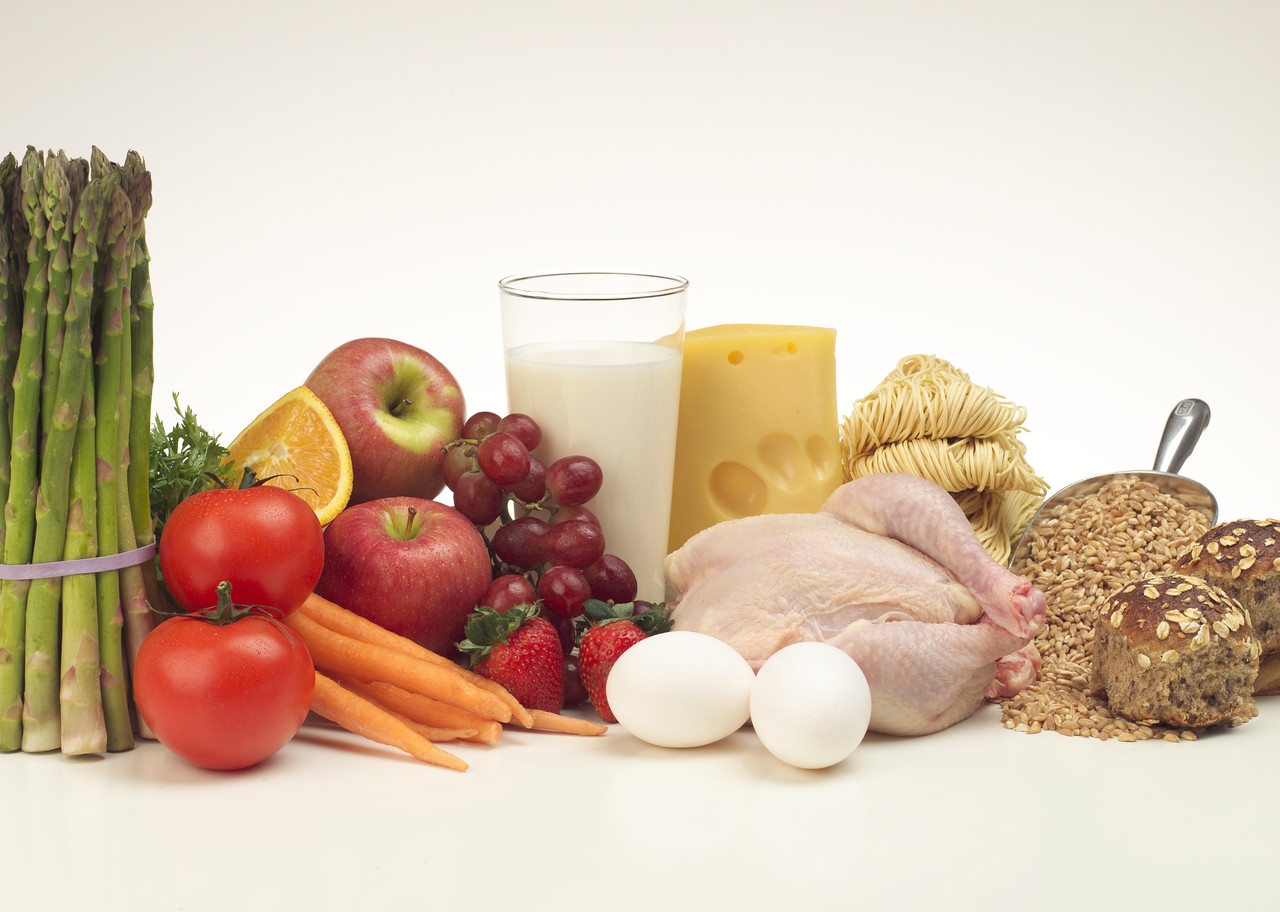
Showing posts with label macronutrients. Show all posts

Monday, November 10, 2014

Are You Eating the Right Grains?

Did you know you know there's a simple way to help lower your blood pressure, improve your cholesterol, and reduce your risk of dying from all sorts of scary-sounding things—and you don't even have to leave the dinner table to do it?

Intrigued? Then consider replacing the refined grains in your diet with whole grains. What are whole grains? They are cereals and seeds that have not been milled or processed to remove their hard exterior. This outer layer, called the bran, contains healthy oils, fiber, and protein. This is stripped away when the grain is refined. Whole grains are complex carbohydrates that take the body longer to digest, so their nutrition is released slowly and continuously, leaving you feeling energized and full for much longer, partly because they don't spike your blood sugar. They are an excellent source of dietary fiber, protein, iron, potassium, and manganese.

Misleading food labels have sparked plenty of confusion about what is and isn't made from whole grain. The best way to verify if your packaged baked goods are whole grain is to read the ingredient list on the back or side. If the grains listed are "whole," then you're in good shape. An even better way to know you are eating whole grains is to buy them whole and cook them yourself.

Some of the whole grains you might be familiar with include brown rice, quinoa, and oats, and these are fantastic. But, did you know there are a lot of other whole grains—many of which have been enjoyed around the world for thousands of years—that you can add to your meals for variety? Look for them in the bulk bins or dry goods section of your local market, where many will cost just pennies per serving. Stretch your dollar farther by blending the more exotic varieties with brown rice, buckwheat, and quinoa. Experiment to find your favorite flavor combination!

If you can cook rice or oatmeal, you can easily cook other grains. We've provided measurements and cooking times for you below. Use a heavy pot with a lid (or a rice cooker!) and set the burner of your stove to a medium temperature. All grains should be rinsed well before cooking and inspected for stray twigs or stones that remain from the harvesting process.

Substitute whole grains in place of white rice or pasta, add them to soup and casseroles, toss cooked grains into salads, or serve them for breakfast and enjoy like oatmeal. Cooked grains keep well in the fridge, so we recommend making a large batch and storing the leftovers for quick meals during the week. Store uncooked grains in an airtight container in a cool, dark cabinet for up to 6 months, or in your refrigerator as long as a year.

Here are 7 up-and-coming whole grains to try: 

AMARANTH

While not technically a grain (it's a seed), gluten-free amaranth has a nutritional profile similar to grain. Originally from Peru, its cultivation spread through Central and South America and played a crucial role in Aztec rituals and their diet. Amaranth contains more protein than most grains, is considered a complete protein, has three times as much calcium as other grains, is rich in iron and magnesium, and is the only grain that contains vitamin C. It has been shown to lower blood cholesterol in patients with coronary disease and hypertension.

To Cook: Add 1 cup amaranth to 3 cups water, and simmer gently for 20 to 25 minutes, stirring occasionally. Cooked amaranth has a consistency similar to Cream of Wheat (it can become sticky if overcooked). For a dish that is more like rice, combine amaranth with other cooked grains. You could also add a few tablespoons while cooking homemade soup to add thickness and protein. 

BUCKWHEAT

You may already be familiar with buckwheat—no, not the character from The Little Rascals—the grain. Only, once again, it's not a grain at all or even related to wheat. This heart-shaped seed is a relative of rhubarb, making it gluten-free. Buckwheat has a satisfying, nutty flavor and numerous health benefits. The phytonutrients in buckwheat are powerful antioxidants that protect cells from cancer-causing free radicals. Buckwheat is also a star when it comes to keeping the heart pumping—its fiber has been shown to reduce high blood pressure and cholesterol levels4 and its manganese promotes healthy circulation.

Make it a staple in your pantry, and you'll be glad you did. It cooks quickly for a weeknight dinner, and can be made ahead in bulk and stored in the fridge for easy lunches throughout the week. Buckwheat flour makes delicious pancakes and crepes. Soba noodles made from buckwheat are a great gluten-free alternative to pasta.

To cook: Prepare it like rice on a stovetop or in a rice cooker. Pre-toasting in a dry pan before adding liquid intensifies the nutty flavor and is worth the effort. Bring 1 cup buckwheat and 2 cups water to a boil, reduce heat to low, put a lid on it, and simmer 10 to 15 minutes, or until all the water is absorbed and the kernels are tender. 

FARRO

Farro is an ancient relative of wheat that has been eaten for centuries. Want to look like a gladiator (or a goddess)? Then eat farro, the grain that fortified the armies of the Roman Empire. Farro is sometimes called spelt or emmer, but they're not the same. Farro has a firm and chewy texture, and a nutty flavor that is great in grain salad, stuffing, and soup. It is surprisingly filling because it has 11 grams of protein and 8 grams of fiber per cup. It is so nutritiously dense, in fact, that you might find a smaller serving than other grains will make you feel full. The fiber supports healthy digestion and satisfies for hours, making it a healthy choice for people trying to lose weight.

To cook: Farro also benefits from toasting. Add 1 cup farro to 2-1/2 cups boiling water. Cover and simmer without stirring for 20 minutes, or until tender. Farro can be cooked in a rice cooker and makes great leftovers because it keeps its firm texture for several days and never gets mushy or sticky. 

KAMUT

Legend has it that a Montana man discovered several kamut seeds in a tomb near the Nile River. Later, an enterprising farmer trademarked the seeds and gave it the ancient Egyptian name for wheat.

One thing is certain, kamut is an ancient grain. It is an heirloom variety of Khorasan wheat from Iran. Research suggests that ancient grains may have more health benefits than modern strains of wheat, and recently, Canadian scientists compared several ancient grains, including kamut, to modern wheat, and found higher levels of lutein (important for eye health) and beta-carotene in the heirloom grains.

Kamut is a smart choice for a healthy diet and, as an added bonus, the branded product is always grown organically. It is high in selenium (which supports the immune system), zinc, and manganese. It also has 20 to 40% more protein per serving than regular wheat. A half-cup serving provides 6 grams of protein and only 140 calories.

To cook: Kamut is a Goliath of grains, and takes a long time to cook. Bring 1 cup kamut and 3 cups water to a boil, reduce heat, and simmer until the grains are plump and chewy.  This can take 1-1/2 to 2 hours. Soaking the grains overnight will reduce cooking time. 

KAÑIWA

Though the name sounds similar, don't confuse kañiwa (pronounced "ka-nyi-wa") with its popular cousin, quinoa. Kañiwa, from the Andes Mountains, is being touted as the next superfood. These tiny ruby red seeds are about half the size of quinoa and have a mild, sweet flavor. Because they are made up mostly of outer shell, they stay pleasantly crunchy when cooked.

To cook: Add 1 cup kañiwa and 2 cups water to a small pot and bring to a boil. Reduce heat and simmer uncovered for 10 to 15 minutes, until the seeds look they have sprouted little halos (like quinoa). Fluff with a fork and serve. Try it as a "breading" for meats. 

MILLET

Some people think millet is for the birds, literally. It is a main ingredient in birdseed mixes, but this gluten-free seed (again, not a grain) is delicious and fluffy when cooked. It is not commonly eaten in the U.S., but it is the sixth most popular grain in the world. Millet may have been the staple grain of Asia before rice, and it's rich in phosphorous, which is important for strong bones, and is also a source of tryptophan, an amino acid that helps reduce stress.

To cook: Toast 1 cup millet in a dry pan then add 3 cups water. Simmer covered for 15 minutes, then set it aside and leave the lid on for 15 minutes more. Fluff with a fork before serving.

For hot cereal or polenta, grind millet in a spice grinder. Bring 5 cups water to a boil, then gradually whisk in 1 cup millet. Cover, lower heat, and simmer, stirring occasionally for 15 to 30 minutes until grits are tender. The tiny seeds can even be popped like corn! 

WILD RICE 

Just like how many of these "grains" aren't really grains, wild rice is not really rice. It's the seed of an aquatic grass that was originally cultivated in shallow waters across North America. It has double the protein and fiber of brown rice and 30 times greater cancer-fighting antioxidant activity than white rice.  Reddish brown to black in color, wild rice commands attention with its toothsome bite and bold nutty flavor. For this reason, and also because it's pricey, it is often blended with other grains.

To cook: Wild rice requires more time to cook than most grains, but it's worthy of the extra patience.  Bring 3 cups water or stock to a boil, stir in 1 cup rice, reduce heat, and simmer covered for 50 minutes, until the kernels burst open, revealing a creamy interior. Uncover, fluff with a fork, and continue cooking over low heat for 5 minutes more if needed. Overcooking causes kernels to curl up and loose their distinct texture.

So the next time you are in the store, head to the grain/dry foods section and pick up some of these healthy grains.  Remember, carbs are not bad!!  These are just a few examples of healthier choices.  Enjoy!!

Monday, January 20, 2014

When Should I Listen to My Cravings???


Cravings can be intense—and often they go way beyond minor hankering. Surely, it can't just be that you want chocolate. There must be some reason that you need chocolate. Come on, please! Just a taste. 
Unfortunately, you probably don't. In most cases, cravings aren't a physiological function telling you what you need. In fact, it's much more like that that they're a dysfunction.  
You might be aware of an infographic floating around the internet featuring foods that people typically crave, along with micronutrients that (supposedly) trigger those cravings. If you desire bread, toast, or pasta, the graphic suggests you need more nitrogen in your diet. Salty foods mean you need chloride, chocolate suggests a need for magnesium, etc. You may notice a complete lack of references at the bottom of this chart. That's probably because there's no science backing up these claims—whatsoever. While the craving might stem from something more obvious—sugar, for example—it's highly unlikely that your "need" for chocolate means you need more magnesium in your diet.  
Why Do I Crave Chocolate and Other Foods That Aren't Good For Me?
Cravings are far more complex than this cause-and-effect chart suggests. While a subtle nutrient need may be partly to blame, cravings arise for several reasons and tend to include a tangled web of psychology, hormones, and other physiological issues.  
Let's go back to the chocolate/magnesium connection. By the time chocolate gets to the milked-down form most Americans consume, there's not much magnesium left. One ounce of milk chocolate contains just 4% of the recommended daily value for magnesium. Dark chocolate has 16%.  Why would the body seek out a food for a specific nutrient when that food has very little of that nutrient? Wouldn't it make more sense that your body would crave foods richer in magnesium, such as nuts, leafy greens, or beans? Your chocolate cravings probably exist for more insidious reasons. Some research shows similarities between chocolate cravings and alcohol addiction, in that both alcohol and cacao contain similar neuroactive alkaloids (chemicals that tweak your melon). In other words, research suggests that chocolate is addictive.  
Another reason you could be craving that brownie is because of your emotional history with it. It's one of the great American comfort foods. We're brought up identifying chocolate with birthdays, Halloween, post-soccer game ice cream outings, and all those magic moments when you were a good little boy or girl who deserved a reward. If you can't see how that would etch a positive association neural pathway deep into your gray matter, we need to get Dr. Freud on the horn, stat.  
Furthermore, unless you like chewing on cacao nibs (and some people do!), the chocolate you consume is filled with sugar—and sugar cranks up the "feel good" hormone serotonin (among other chemicals) levels in your brain, giving you a feeling of mild euphoria. When it's gone, you want more. Combine this sugar hit with the emotional issues and you've got one powerful craving.  
We're not ruling out the possibility of a causal relationship between cravings and micronutrients—but the key word here is possibility. For instance, when first beginning an exercise program, you might find yourself with an irresistible craving for potato chips or salty carbs. By adding a little sea salt to a recovery drink that those cravings my pass. Similarly, pregnant women often crave foods that are high in nutrients they need. For example, she might crave cheeseburgers—an obvious source of calcium and iron.  
If you're convinced that your particular craving stems from a micronutrient deficiency, there's an easy way to test this: supplement the vitamin or mineral you have in mind. Getting back to chocolate, if you buy into the magnesium thing, try supplementing Beverly International UMP. Another angle would be to embrace the psychology aspect of cravings so that you can indulge yourself, but in a healthy way.
Maybe sometimes. With all this talk of micronutrients, we've overlooked another possible root cause for your craving—a macronutrient deficiency. You could be craving certain foods—or certain food types—because your balance of carbs, protein, and fat is off. While it's a stretch to assume your body desires a food because it contains trace amounts of a certain mineral, the causal link between foods and macronutrients (carbs, protein, and fat) is obvious. Eat a piece of carb-heavy cake and you're going to spike your blood sugar.  
If you think this may be the case, feed the craving with healthy food. If you're craving sweet things, increase your fruit and veggie intake. If you crave greasy foods, increase your raw nut or avocado (good fats) intake. If you find yourself craving meat and cheese, increase your lean protein intake with chicken, fish, eggs, and legumes. If you do this and it doesn't work, odds are that your cravings are more psychologically based.  
If you're deliberately eating at a calorie deficit, this method can be a problem. Ultimately, you're not getting enough of any macronutrient. In these situations, it might be useful to adjust the balance of carbs/protein/fat in your diet.
Cravings suck. And when you're trying to lose weight, they suck even more, as calorie deficits tend to increase cravings. In our most frustrated, "give-me-the-donut-before-I-kill-someone" moments, we'd all like a simple solution. Unfortunately, it doesn't exist. Finding your way around cravings requires a little patience and experimentation. It's just a matter of finding a healthy substitute, a little willpower—or some combination thereof.

Wednesday, September 19, 2012

Nutrition and Injury Recovery

Unfortunately we've all been there before...recovering from some sort of injury.  We've sat on the sidelines a time or two, waiting (sometimes impatiently) to get back on the court/field/course.  While you were waiting, what did you do?  Probably you rested, maybe you did some sort of therapy either through a medical professional or on your own.  But did you take into consideration your nutrition plan while you were recovering?  Probably not.  Nutrition is so important, not only when you are healthy but also when your body is going through its repair process.  This blog will give you a few ideas on how to improve your nutrition plan during recovery to lessen the time spent on the sidelines.

During the injury healing process, inflammation occurs almost immediately and can last up to 5 days post-injury.  This is when the body sends extra help to the injured area to help speed up recovery.  While it may be uncomfortable with swelling, heat and redness in the injured area, this is an important part of the healing process.  During this time dietary fat plays an important role.  Omega-6 fats and trans-fats both promote inflammation in the body while omega-3 fats and monounsaturated fats both inhibit inflammation.  As much as you want the swelling to go down, it is vital to allow the body to promote natural healing.  Therefore, during the injury recovery process, especially within a few days of injury, you should up the intake of omega-6 fats slightly.  The ideal ratio during recovery is 2-3 omega-6 fats to every omega-3 fat.  The easiest way to do this, without getting into calculating fat contents, is to increase your intake of olive oil, mixed nuts, avocados, flax oil, ground flax, and other seeds, etc., making sure to get some of each fat source every day.  By eating these foods, you'll likely balance out the saturated fats naturally present in your protein sources.  In addition to that, add approximately 3-6g of fish oil while decreasing your omega-6 fat (i.e., corn oil, safflower oil, processed foods) intake.

Another route you can take to help your body recover from injury is to add certain spices/herbs to your daily nutrition plan.  Because of the side effects of NSAIDs (non-steroidal anti-inflammatory drugs) like ibuprofen and naproxen sodium, many people rely on the anti-inflammatory properties of herbs and spices.  Theoretically, NSAIDs should only be taken during the acute phase of the injury (5 days post injury) because when taken early in the healing process, it rapids blocks the inflammation process.  Remember, this is an important phase because the body sends chemicals to the affected area to clean up the injury and start the healing process.  If inflammation is blocked too early, the body may take longer to heal.  Some herbs and spices that are helpful are:
  1. Curry powder/turmeric – This member of the ginger family has long been used as an anti-inflammatory and for wound healing.  The active ingredient, curcumin, is likely responsible for the effects.  Aim for 1 tsp per day of the powder or 400-600mg of the supplement, 3 times per day. 
  2. Garlic – This has been shown to inhibit inflammatory enzymes.  Adding it to the diet is helpful, but a supplement might be even better.  Aim for 2-4 garlic cloves each day (if you can tolerate it) or 600 to 1,200mg of aged garlic extract. 
  3. Boswellia – A favorite of Ayurvedic medicine, boswellia has many pharmacological uses.  As an anti-inflammatory, try 300mg 3 times per day. 
  4. Pineapple – Bromelain, found in pineapple, is another anti-inflammatory that’s great for digestion and for inflammation/pain relief.  Aim for 2 cups of pineapple per day or 500-1,000mg in supplemental form.
Calorie intake is another important area to take into consideration.  When physical activity is limited or training stops, the body will naturally need less calories to function.  However, even though the training stops, your body still needs an increase in calories to support the healing process.  Many people undereat when they are injured which can slow down the healing process.  Depending on the severity of the injury, your body will need 15-50% more calories than your basal metabolic rate (BMR).  BMR is the amount of calories needed to sustain life and for your body to function at rest.  So while you may not need as many calories during injury healing as you do during active training, it still will be higher than what your body requires when sedentary.

Finally, macronutrients such as protein, carbs and fat should be consumed in sufficient quantities to help the body heal.  Protein should be about 1g per pound of body weight; 1/3 of your diet should come from fat and that amount should be further broken down to include 1/3 saturated fat, 1/3 monounsaturated fat, and 1/3 polyunsaturated fat.  In terms of carbohydrates, there is no recommended level for injury recovery.  You should consume enough carbohydrates to support brain function and provide adequate macronutrient intake.

The important thing to remember is to be sure to eat frequently throughout the day and incorporate the principles listed above to ensure you are consuming high quality, nutrient-dense foods.  Your body will recover quicker and you will be back on the playing field again.  If you still need help with figuring out what to eat during injury recovery, contact PROMATx Health Club and set up an appointment with our nutrition specialist.  We are here to help and we are able to guide you through your recovery process.

Monday, April 9, 2012

Is It Possible to Lose Weight While Eating Out?

What would you give up to lose weight?  Would you stop eating out at restaurants?  Recent research shows you may not have to give up dining trips to restaurants.  In a study published in the Journal of Nutrition Education and Behavior in January 2012, researchers at the University of Texas at Austin developed a "weight-gain prevention" intervention.  Their goal was not to provide a weight loss program but to teach participants how to prevent weight gain while still having the ability to eat out at restaurants.  In this study, 35 women between the ages of 40 and 59 who ate out frequently were recruited for this 6-week program.  The main purpose of this program was to teach participants how to reduce caloric and fat intake while eating out.

What was the outcome?  The intervention group not only prevented weight gain while eating out, they actually lost an average of 3.7 pounds.  How?  The skills these participants learned in the program carried over to their dietary habits at home.  Based on food journals completed in the study, the intervention group reduced their caloric intake at restaurants by 124 calories.  In addition, they reduced total daily calories by 297 calories (this includes the calorie reduction when eating out).  Therefore, this total calorie reduction resulted in weight loss.  What is even more interesting is that these participants did NOT reduce the number of times they ate out even though they participated in the study!!

So this shows us that it is possible to enjoy foods that other people cook and still at least maintain weight or even lose weight.  By learning skills on how to make better choices, we have the tools to make weight loss that much easier.  Where do you start?  First it is important to learn a little about food and what the "macronutrients" are in food.  Over the next few blog entries, we will look at macronutrients (i.e., fat, protein, carbohydrates) and teach you what they are and how they will affect your weight gain/maintenance/loss.  We will begin to teach you these skills necessary to make better choices.  

Still need extra help?  Why not come in to PROMATx Health Club and talk with our nutrition specialist?  Find out how well-balanced your nutrition is and find out how you can ensure you receive the proper nutrients.  As usual, we are here to help you but you have to make the first step.  Call us today and set up your appointment.  Make your weight loss permanent so you don't cycle through weight gain and weight loss every few years.

Study reference:  Elsevier Health Sciences (2012, January 10). Would you stop eating out to lose weight?. ScienceDaily. Retrieved April 9, 2012, from http://www.sciencedaily.com­ /releases/2012/01/120110093557.htm