

Do you religiously step on the scale every week to check your progress with weight loss? Are you struggling with losing that last 5-10 pounds? Have you already lost the weight and are looking to maintain your successes? Instead of just stepping on that scale, you should have your body composition analyzed by a health/fitness professional. While just looking at body weight is important, it is also wise to know exactly how much fat mass you have versus lean mass. Fitness professionals can analyze body composition in a number of ways: waist-to-hip ratio, BMI (body mass index), and body fat calculation.

First, let's look at waist-to-hip ratio. This is a general way for a health and fitness professional to estimate your health risk for diseases such as obesity, heart disease, and diabetes. Circumference measurements are taken of the smallest part of your natural waist (just above the belly button) and the widest part of your hips/buttocks. Then divide the waist measurement by the hips (both in inches). Low risk for women is 0.8 or below and 0.95 or below for men. Essentially "apple-shaped" bodies are more at risk than "pear-shaped" ones.
Next, BMI or body mass index, can be calculated. This test looks at your height versus your weight. Here's the formula for calculating BMI: weight (lb) / [height (in)]2 x 703. For example if you are 5'5" (65 inches) and weigh 150 pounds the formula looks like this: [150 / (65x65)] x 703 or [150 / 4225] x 703. Your calculation would be 24.96. Healthy ranges for both adult men and adult women is 18.4 - 24.9. Remember, this is an estimation of risk. BMI calculation does not take into consideration how much lean mass a person has so BMI will be overestimated for individuals who have higher lean mass (i.e., body builders) and underestimated to those who have lost lean mass (i.e., elderly).

A more accurate picture of body composition can be obtained through body fat analysis. This can be done through various testing procedures such as bioelectrical impedance (hand-held units), full-body scans such as BOD POD, and skinfold measurements (via calipers). The most convenient and, probably more readily available, is bioelectrical impedance analysis (BIA). This is the most inexpensive method and only requires a hand-held unit. The principle behind BIA is that fat contains little water; most of the body’s water is in the lean compartment (i.e., muscle, bone, organs). Therefore, when an electrical current encounters fat, there is more resistance. By measuring how easily currents move through the body, body fat can be estimated.
Full-body scans, such as BOD POD, are more expensive but provide much more detail. These fiberglass units are designed to measure body weight and body volume (i.e., the body’s total size). Because fat is less dense than lean tissue, the weight-to-volume ratio can be used to predict percent body fat. This is a little more "high-tech" and is usually found in university or hospital settings or in more specialized health/fitness clinics.
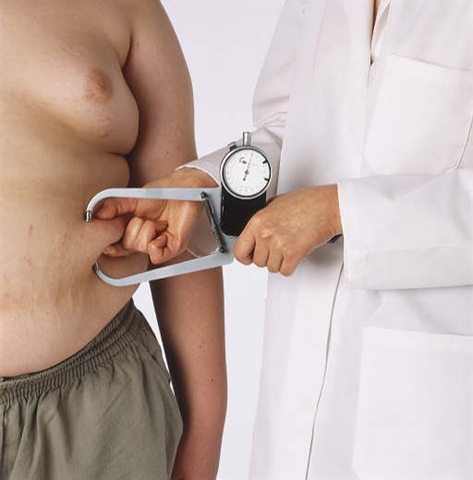
Now that you are familiar with some of the common procedures to analyze body composition, maybe it's time for you to have one of these tests done. Whichever method you choose, it is important to have a fitness professional administer the test. That way your results can be properly explained to you, health risks, if any, identified, and a plan of action can be developed. Here at PROMATx Health Club, we have specially-trained fitness professional who can administer all of the methods listed above, with the exception of the BOD POD.
Remember, body composition can change but the number on the scale can remain the same. You can lose fat and gain muscle at the same ratio and your body weight will remain unchanged. Fitness professionals can help you determine healthy ranges of body fat for you as well as design a program geared towards improving your fat mass to lean mass ratio. Don't just rely on your scale. Get a better picture of your overall health and what your disease-related risks are. Stop in today and make an appointment for a body composition analysis. Don't worry...it won't hurt! It will, however, arm you with valuable information to help you progress with your weight loss. Call us today!!
