Showing posts with label BMI. Show all posts

Wednesday, August 22, 2012

Does Feeling Fat Make You Fat?

We have all those days.  The ones where you feel fat and frumpy.  But just because you "feel" fat, does that make you fat??  According to a recent study published in the Journal of Obesity by the Norwegian University of Science and Technology, normal-weight teens who felt fat were more likely to grow up to be fat.  This study was an eleven-year follow-up that tracked 1196 normal-weight teens as they progressed into adulthood (between ages 24 and 30).  

According to the results of this study, researchers found that half of the participants still maintained a healthy weight as an adult.  Unfortunately, the results also showed that 59 percent of the girls who felt fat as a teen later became an overweight adult (based on body mass index, or BMI).  This is in comparison with 31 percent of girls who did NOT feel fat as a teenager but developed into overweight adults.  This study also showed that normal-weight girls were more likely to perceive themselves as overweight in comparison to normal-weight boys.  Twenty-two percent of the girls in the initial study felt they were overweight whereas only nine percent of boys felt this way.

Why is this??  According to the researchers, psychosocial stress is most likely the main culprit.  The need (or the want) for maintaining an ideal body weight according to social pressure can cause people, especially teenage girls, to gain weight as they progress into adulthood.  This psychosocial stress can cause poor habits such as improper dieting and skipping meals.  Both of these result in weight gain.  Unfortunately, teenage girls are affected more by this psychosocial stress due to media pressure for girls to be thin.

The media's notion of the "ideal" body type for women is based on celebrities and super models.  Young people, both female and male, need to have positive (and healthy) role-models, not ones who severely restrict their calorie intake or engage in unhealthy dietary habits.  Make sure you spend time with your children, grandchildren, nieces, and nephews to ensure they understand what the "ideal" body type is and how to properly achieve healthy results.  Keep kids active and limit time spent in front of the television, video games, and computers.  Schedule family "play-time" to get everyone involved and active so you can help young adults improve their self-esteem.

Need help with getting your teen involved and active?  Check with your school or local government to see what programs or assistance is available to you.  Also, check at local gyms or health clubs for after-school activities or sports for your teens.  Set an example by being active yourself and make appropriate food choices.  Together, we can help turn these statistics around and make the future for our children brighter, happier, and most importantly, healthier!!

Norwegian University of Science and Technology (2012, August 8). Feeling fat may make you fat, study suggests. ScienceDaily.

Wednesday, May 16, 2012

Body Composition...Do You Know Yours?

Do you religiously step on the scale every week to check your progress with weight loss?  Are you struggling with losing that last 5-10 pounds?  Have you already lost the weight and are looking to maintain your successes?  Instead of just stepping on that scale, you should have your body composition analyzed by a health/fitness professional.  While just looking at body weight is important, it is also wise to know exactly how much fat mass you have versus lean mass.  Fitness professionals can analyze body composition in a number of ways:  waist-to-hip ratio, BMI (body mass index), and body fat calculation.  

First, let's look at waist-to-hip ratio.  This is a general way for a health and fitness professional to estimate your health risk for diseases such as obesity, heart disease, and diabetes.  Circumference measurements are taken of the smallest part of your natural waist (just above the belly button) and the widest part of your hips/buttocks.  Then divide the waist measurement by the hips (both in inches).  Low risk for women is 0.8 or below and 0.95 or below for men.  Essentially "apple-shaped" bodies are more at risk than "pear-shaped" ones.  

Next, BMI or body mass index, can be calculated.  This test looks at your height versus your weight.  Here's the formula for calculating BMI:  weight (lb) / [height (in)]2 x 703.  For example if you are 5'5" (65 inches) and weigh 150 pounds the formula looks like this:  [150 / (65x65)] x 703 or [150 / 4225] x 703.  Your calculation would be 24.96.  Healthy ranges for both adult men and adult women is 18.4 - 24.9.  Remember, this is an estimation of risk.  BMI calculation does not take into consideration how much lean mass a person has so BMI will be overestimated for individuals who have higher lean mass (i.e., body builders) and underestimated to those who have lost lean mass (i.e., elderly).

A more accurate picture of body composition can be obtained through body fat analysis.  This can be done through various testing procedures such as bioelectrical impedance (hand-held units), full-body scans such as BOD POD, and skinfold measurements (via calipers).  The most convenient and, probably more readily available, is bioelectrical impedance analysis (BIA).  This is the most inexpensive method and only requires a hand-held unit.  The principle behind BIA is that fat contains little water; most of the body’s water is in the lean compartment (i.e., muscle, bone, organs). Therefore, when an electrical current encounters fat, there is more resistance.  By measuring how easily currents move through the body, body fat can be estimated.

Full-body scans, such as BOD POD, are more expensive but provide much more detail.  These fiberglass units are designed to measure body weight and body volume (i.e., the body’s total size). Because fat is less dense than lean tissue, the weight-to-volume ratio can be used to predict percent body fat.  This is a little more "high-tech" and is usually found in university or hospital settings or in more specialized health/fitness clinics.

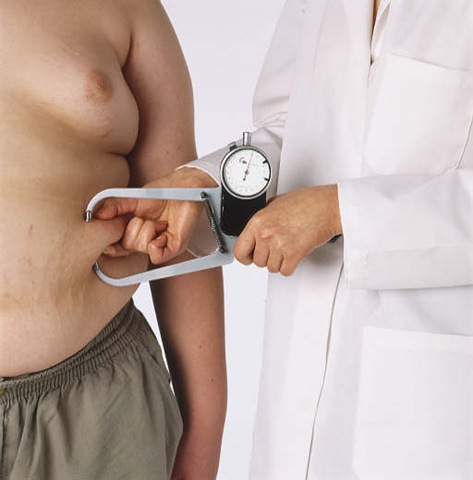
Finally, body composition can be analyzed via skinfold measurements.  Specialized calipers (i.e., "pinchers") are used to measure the thickness of skinfolds in certain areas.  These measurements are then entered into a lengthy calculation, taking into consideration height, weight, age, and gender.  While skinfold measurements are considered to be the "gold standard" of body composition measurements, it does require a specially-trained technician to perform this test.  Inaccurate measurements can drastically alter the final body fat calculation.

Now that you are familiar with some of the common procedures to analyze body composition, maybe it's time for you to have one of these tests done.  Whichever method you choose, it is important to have a fitness professional administer the test.  That way your results can be properly explained to you, health risks, if any, identified, and a plan of action can be developed.  Here at PROMATx Health Club, we have specially-trained fitness professional who can administer all of the methods listed above, with the exception of the BOD POD.

Remember, body composition can change but the number on the scale can remain the same.  You can lose fat and gain muscle at the same ratio and your body weight will remain unchanged.  Fitness professionals can help you determine healthy ranges of body fat for you as well as design a program geared towards improving your fat mass to lean mass ratio.  Don't just rely on your scale.  Get a better picture of your overall health and what your disease-related risks are.  Stop in today and make an appointment for a body composition analysis.  Don't worry...it won't hurt!  It will, however, arm you with valuable information to help you progress with your weight loss.  Call us today!!

Thursday, August 18, 2011

Kentucky Ranked 4th Fattest State

How does it make you feel when hear that our state is the fourth fattest state?  If you are like many of us in the health and wellness field, you should feel frustrated.  An article published by the Morbidity and Mortality Weekly Report (MMWR) in August 2010 reported state-specific obesity prevalence among adults in the United States for 2009.  For this report, obesity was calculated as self-reported height and body weight and defined as body mass index (BMI) greater than or equal to 30.  BMI is a calculation of height versus weight and a healthy range is 18.5 - 24.9.

A total of 33 states had obesity prevalences of 25% or higher; nine of those states (Alabama, Arkansas, Kentucky, Louisiana, Mississippi, Missouri, Oklahoma, Tennessee, and West Virginia) had prevalences of 30% or higher.

Do you know what your BMI and body fat percentage are?  You should...and we here at PROMATx Health Club can help you calculate it.  We can schedule you for a fitness assessment with our Exercise Physiologist.  She will sit down with you and measure your risk for heart disease as well as determine your baseline level of fitness.

In the meantime, what are you doing to prevent obesity?  Here are some easy tips from the Centers for Disease Control:

  • Eat more fruits and vegetables and fewer foods high in fat and sugar.
  • Drink more water instead of sugary drinks.
  • Limit TV watching in kids to less than 2 hours a day and don't put one in their room at all.
  • Promote policies and programs at school, at work, and in the community that make the healthy choice the easy choice.
  • Try going for a 10-minute brisk walk, 3 times a day, 5 days a week.
Better yet...come in to PROMATx Health Club and transform yourself into a better you!!  Our trainers have the resources, knowledge and experience to battle this complex problem.

Transform today!!